Sumplur or Gymnopetalum chinensis or Gymnopetalum cochinchinense (Trichosanthes cochinchinensis) is a plant species in Cucurbitaceae, the stems grow elongated for vine or climb, branched many tubes, green and hairy.
T. cochinchinensis has a stem or branching end that threads to attach to a support or other plant. Plants grow to climb to cover a support, usually another plant, up to several meters, creeping up on the ground to reach another support.
The leaves are arrow-shaped, the base is split, the tip is sharp and two wings with acute angles, serrated edges, has many veins that end at the sharp edges, rough surface, green, hairy and has a long stalk.
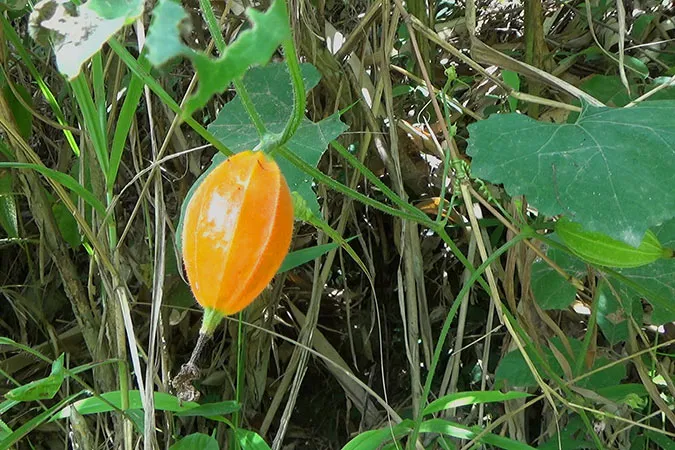
The single flower is white and 3 cm in diameter. The fruit is oval, 3-5 cm long, base narrows, tip narrows and ends with a tail, has about 10 linear ribs, hairy, young green and turns red or orange with maturity, has short and hanging stalks.
Sumplur grows wild in primary and secondary forest, agricultural land, roadsides, watersheds, especially on slopes, humid and dry, shady and lots of sun, altitude around 600 meters, not recorded being used and cultivated.
Kingdom: Plantae
Phylum: Tracheophyta
Subphylum: Angiospermae
Class: Magnoliopsida
Order: Cucurbitales
Family: Cucurbitaceae
Genus: Trichosanthes
Species: Trichosanthes cochinchinensis
T. cochinchinensis has a stem or branching end that threads to attach to a support or other plant. Plants grow to climb to cover a support, usually another plant, up to several meters, creeping up on the ground to reach another support.

The leaves are arrow-shaped, the base is split, the tip is sharp and two wings with acute angles, serrated edges, has many veins that end at the sharp edges, rough surface, green, hairy and has a long stalk.
The single flower is white and 3 cm in diameter. The fruit is oval, 3-5 cm long, base narrows, tip narrows and ends with a tail, has about 10 linear ribs, hairy, young green and turns red or orange with maturity, has short and hanging stalks.
Sumplur grows wild in primary and secondary forest, agricultural land, roadsides, watersheds, especially on slopes, humid and dry, shady and lots of sun, altitude around 600 meters, not recorded being used and cultivated.
Kingdom: Plantae
Phylum: Tracheophyta
Subphylum: Angiospermae
Class: Magnoliopsida
Order: Cucurbitales
Family: Cucurbitaceae
Genus: Trichosanthes
Species: Trichosanthes cochinchinensis
Comments
Post a Comment