
Santa Barbara daisy (Erigeron karvinskianus)

Santa Barbara daisy (Erigeron karvinskianus) is a species of plant in the Asteraceae, a low shrub with erect or fallen stems, having branches, growing creeping on the ground or rock cliffs, elongated leaves and white and yellow disc flowers.

E. karvinskianus has a stem that grows from the rhizome, strong, erect or fallen, cylindrical, elongated and slender up to 15 cm, has branches, old green or reddish brown, young green and white hair.
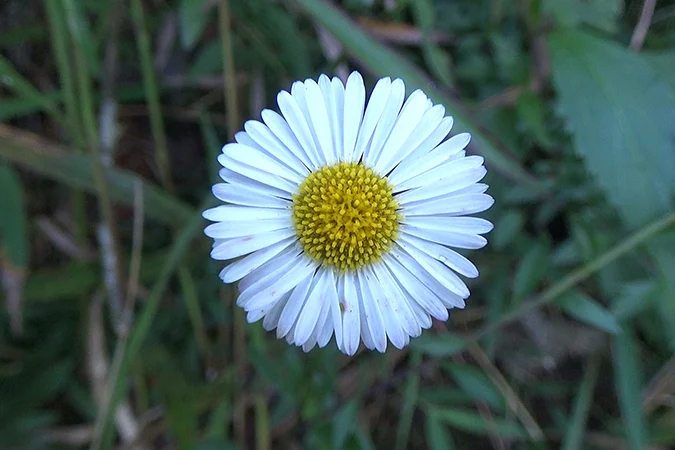
Dlium Santa Barbara daisy (Erigeron karvinskianus)


The leaves grow in rows along the stem, forming a spiral panicle, elongated, pointed tip, a vein in the middle, green and white hair. Flowers grow at the end of the stem, white disc-shaped with yellow in the middle

Santa Barbara daisy grows on forest floors, rock cliffs, often grows in cracks in walls or paving and quickly spreads to carpet flowers as large colonies.


Kingdom: Plantae
Phylum: Tracheophyta
Subphylum: Angiospermae
Class: Magnoliopsida
Order: Asterales
Family: Asteraceae
Subfamily: Asteroideae
Tribe: Astereae
Subtribe: Conyzinae
Genus: Erigeron
Species: Erigeron karvinskianus

Popular Posts

Humpback whales (Megaptera novaeangliae) manufacture bubble-nets as tools to increase prey intake

NEWS - Humpback whales ( Megaptera novaeangliae ) create bubble net tools while foraging, consisting of internal tangential rings, and actively control the number of rings, their size, depth and horizontal spacing between the surrounding bubbles. These structural elements of the net increase prey intake sevenfold. Researchers have known that humpback whales create “bubble nets” for hunting, but the new report shows that the animals also manipulate them in a variety of ways to maximize catches. The behavior places humpbacks among the rare animals that make and use their own tools. “Many animals use tools to help them find food, but very few actually make or modify these tools themselves,” said Lars Bejder, director of the Marine Mammal Research Program (MMRP), University of Hawaii at Manoa. “Humpback whales in southeast Alaska create elaborate bubble nets to catch krill. They skillfully blow bubbles in patterns that form a web with internal rings. They actively control details such ...

Javanese grasshopper (Valanga nigricornis)

Wooden grasshopper or Javanese grasshopper ( Valanga nigricornis ) is an animal species of Acrididae, grasshoppers that have at least 18 subspecies, insects with very wide diversity in color and size, sexual dimorphism in which females are larger in size and paler in color. V. nigricornis in males has a length of 45-55 millimeters and females 15-75 mm. The head is square and green or yellow or brown or black in color. A pair of antennas has a black color. The eyes are large and gray or white or brownish. The hind legs are very large and have a green or yellow or brown or black color, plain or brindle. The limbs have two rows of large and long spines with black tips facing backward. The wings have a length exceeding the belly, a rough surface and are brown or green or yellow or black in color with pulse lines forming spaces filled with black color. The hind wings are rose red which will be visible when flying. Nymphs are pale green or yellow or brown or blackish in color. Javanese gr...

Javan mocca or Javan slender caesar (Amanita javanica)

OPINION - Javan mocca or Javan slender caesar ( Amanita javanica ) is a mysterious fungus species and has been enigmatic since it was first reported by Boedijn in 1951 and after that no explanation or reporting of specimens is believed to be the same as expected. Boedijn (1951) described A. javanica which grew on Java island as having the characteristics covered in the Amanita genus. Corner and Bas in 1962 tried to describe Javan mocca and all species in Amanita based on specimens in Singapore. Over time some reports say that they have found A. javanica specimens in other Southeast Asia including also China, Japan, India and Nepal. But there is no definitive knowledge and many doubt whether the specimen is the same as described by Boedijn (1951). I was fortunate to have seen this species one afternoon and soon I took out a camera for some shots. In fact, I've only met this mushroom species once. Javan mocca is an endangered species and I have never seen in my experience in...